What has changed
Alpha 1 now has a proposed external-field model with a defined potential, interaction range, source geometry and observable force. This formulation was developed for the program; it is not a derivation or validation of an original NetPhysics law. The physical existence of this field and a mechanism for changing material coupling remain unestablished.
Two models, two questions
A1-Y is a conditional finite-range field hypothesis. A1-EM is a conventional photon-force benchmark. Agreement with the photon calculation would qualify an optical measurement; it would not establish the hypothetical Alpha 1 interaction.
The candidate field
∇²φ − c−2∂t²φ − λ−2φ = 4πGρq
A1 = −∇φ · F1 = −mqt∇φ
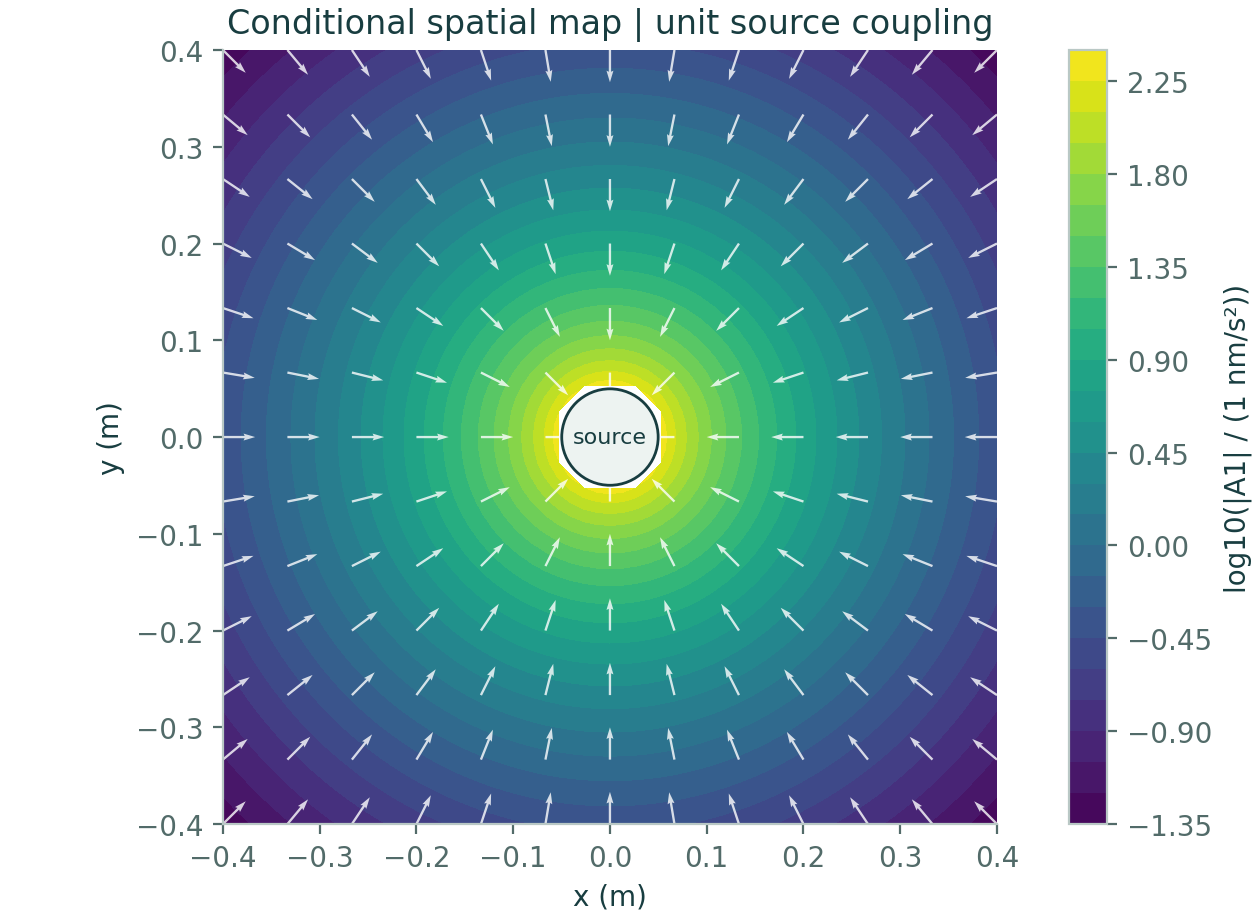
φ is a scalar potential in m²/s²; A1 is its vector acceleration field in m/s². λ is the interaction range, ρ is source mass density, and q is an unknown effective coupling. The state-dependent coupling product b = qsq1 is the parameter to estimate. These are hypotheses to test, not measured constants.
A prediction with declared conditions
The reference calculation uses ideal homogeneous spheres: a 10 kg source, a 0.1 kg target, density 19,300 kg/m³ and range λ = 0.10 m. Finite-radius corrections are included. No device is asserted to have these effective couplings.
| Center separation | Newtonian attraction | Alpha 1 force per unit b |
|---|---|---|
| 0.20 m | 1.6686 nN | 0.6952 nN |
| 0.30 m | 0.7416 nN | 0.1516 nN |
| 0.40 m | 0.4171 nN | 0.03920 nN |
If b = 0, there is no Alpha 1 contribution. A unit b is not an estimated or necessarily allowed value. Existing fifth-force experiments must constrain the candidate before a physical test is justified.
Qualify the instrument with a known force
For a 10 W external light beam, an assumed 80% deflection efficiency and a 30° reflected order, the reference model calculates 13.343 nN of lateral force. Reversing the reflected order changes the force by 26.685 nN. The outgoing photons carry the opposite momentum. These are calculations, not Metric Flight measurements.
A result must reverse twice
The proposed field test reverses the source side and the target state at three separations. Its double-odd force estimate rejects constant, source-only and state-only offsets. It does not reject artifacts that also change with both factors; thermal, magnetic, electrostatic, mechanical and gravity-gradient controls remain necessary.
The analysis includes a failed example
The code passes 19 analytical and numerical checks. A fixed-seed synthetic campaign fails the proposed residual-quality gate and is retained as a rejection example. Synthetic data are labeled throughout. A separate Monte Carlo checks the estimator under its declared Gaussian assumptions; it does not validate an actual instrument.
The next scientific gate
Derive a credible microscopic mechanism for state-dependent coupling and compare it with existing constraints. Stop the new-field hardware branch if that gate cannot be passed. The proposed field exchanges momentum with an external source and does not predict self-acceleration of an isolated vehicle.
Inspect and reproduce
The 17-page report includes governing equations, finite-size calculations, uncertainty assumptions, the proposed experiment, stop/go criteria and 14 linked primary sources. The public ZIP contains the Python model, report source, plots, data tables and integrity hashes. AI assisted formulation, calculations and writing; independent scientific review remains pending.
Download the machine-readable model summary ↓
Research release v0.1.0 · 20 October 2026. No experimental propulsion result, institutional partnership, NASA submission or endorsement is claimed.