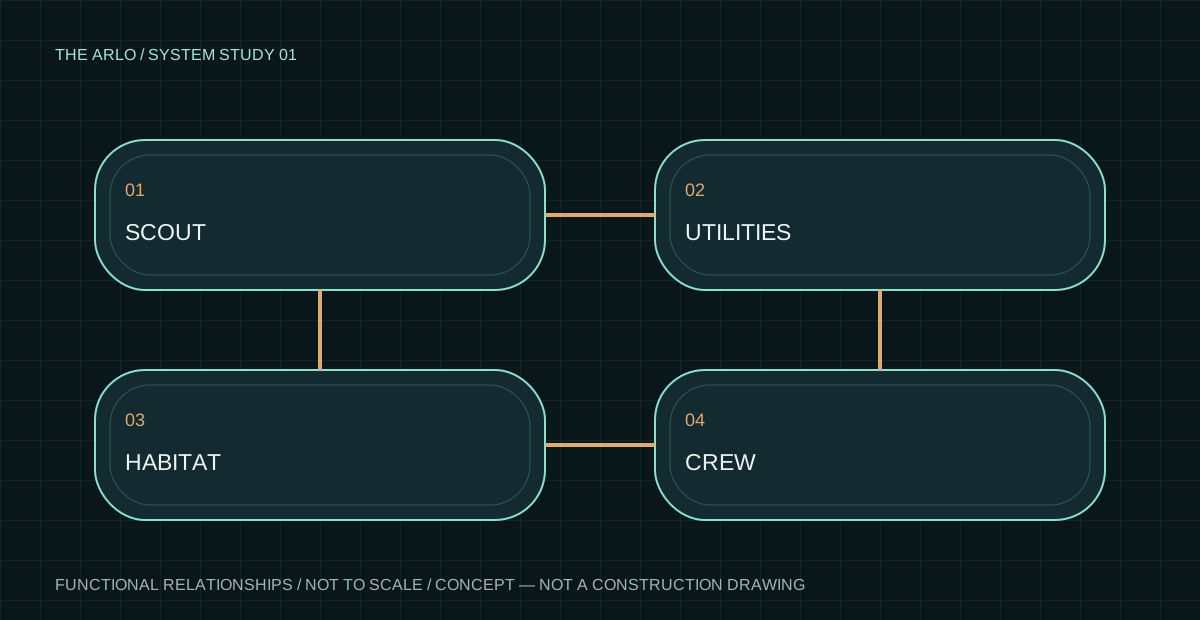
Conceptual adjacency map. Distances, orientations and safe setbacks are not specified. *Landing infrastructure is off-site; shown nearby only for navigation.
ARLO ORIGINAL / ANIMATED EXPLAINER
From a landing to a place to live
Read the film transcript
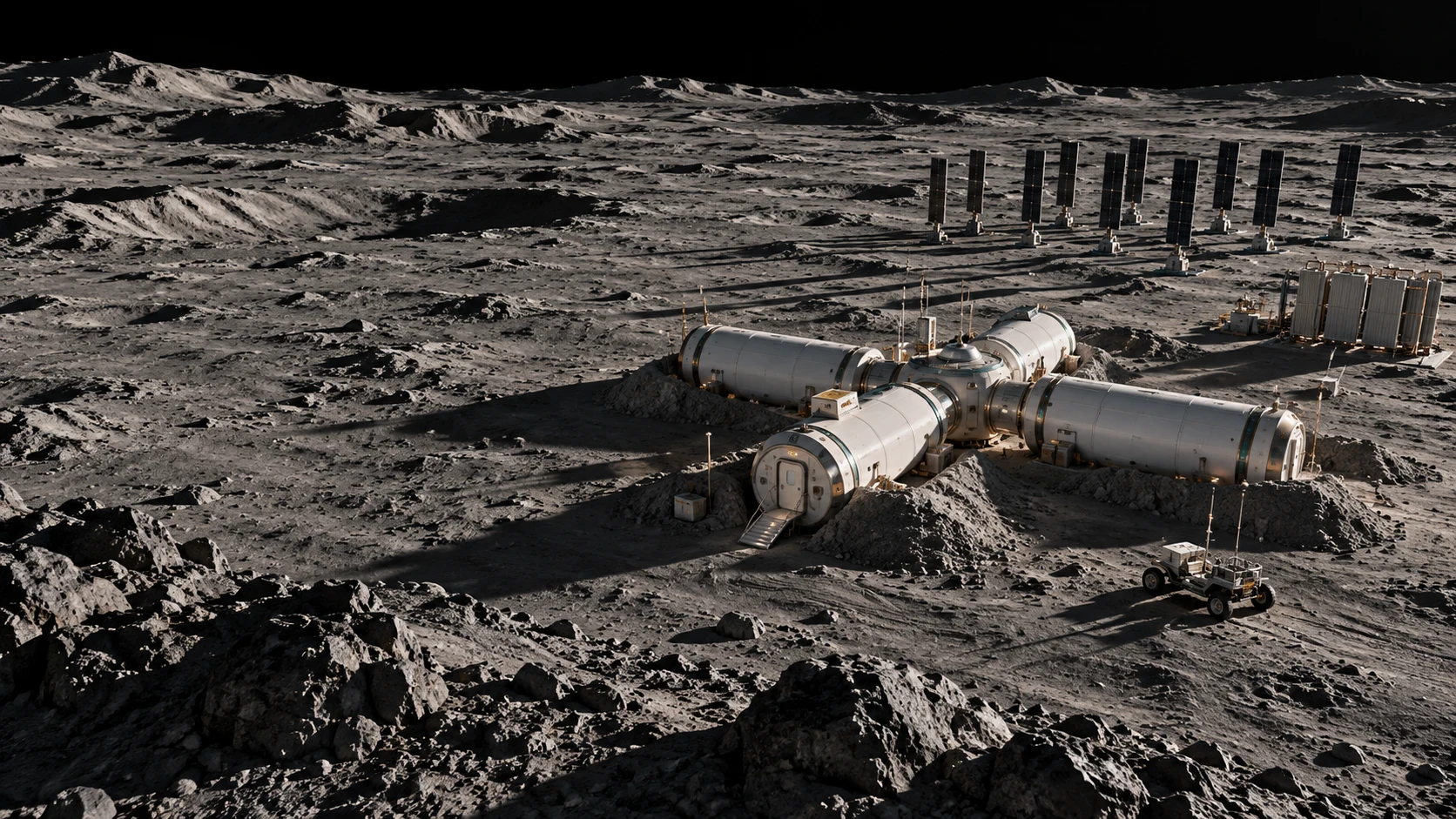
Reconnaissance maps the terrain. Robotic cargo establishes power and communications. Modules are connected and commissioned. An uncrewed endurance test and independent review precede a four-person, 30-day reference mission.
Silent, captioned concept animation. Illustrates the design logic; does not depict built hardware or measured performance.
ARLO functional study 01 · conceptual relationships, not a construction drawing.
DESIGN NOTE 01
A first foothold, designed around people
Our reference mission is four crew members living and working on the lunar surface for 30 days. This is a proposed sizing case, not a booked mission. The first occupation would follow robotic reconnaissance, cargo delivery, systems commissioning and an uncrewed endurance demonstration. A suitable return vehicle must remain available throughout the visit. No crew launch date, landing site, transport contract or completed flight hardware is claimed.
DESIGN NOTE 02
Research that can grow into infrastructure
The station is intended to support geology, dust characterization, instrument testing and investigations of how people and equipment perform in lunar gravity. A compact initial outpost creates a manageable engineering problem: keep a small crew safe, maintain a repeatable science schedule and return samples and operational evidence. Additional laboratories, resource demonstrations and longer stays would follow successful missions.
DESIGN NOTE 03
The architecture starts with known physics
Conventional launch, transfer, landing and ascent are the transport baseline. Pressure vessels retain a breathable atmosphere; electrical systems run life support; external radiators reject waste heat. Metric Flight’s optical-force research and Alpha 1 hypothesis are separate investigations. ARLO does not depend on them delivering propulsion, gravity control or free energy.
DESIGN NOTE 04
What must be true before anyone goes
The full mass and power budgets must close against selected hardware and contracted transport. The chosen terrain needs a verified illumination history, communications coverage and a safe landing approach. The complete station must survive credible failures with enough independent life support, power and consumables for the actual evacuation timeline. This website is the starting design brief and an invitation to qualified engineering review.
Research behind this chapter
Lunar south-pole environment ↗ — NASA; terrain, illumination and environmental constraints. Regional information does not select an ARLO site.
Human-rating guidance ↗ — NASA requirements portal; applicability and current revisions must be established by the mission authority.
Sources checked 23 October 2026. ARLO-specific architecture and numbers are proposed assumptions. Public research references do not imply endorsement or partnership.