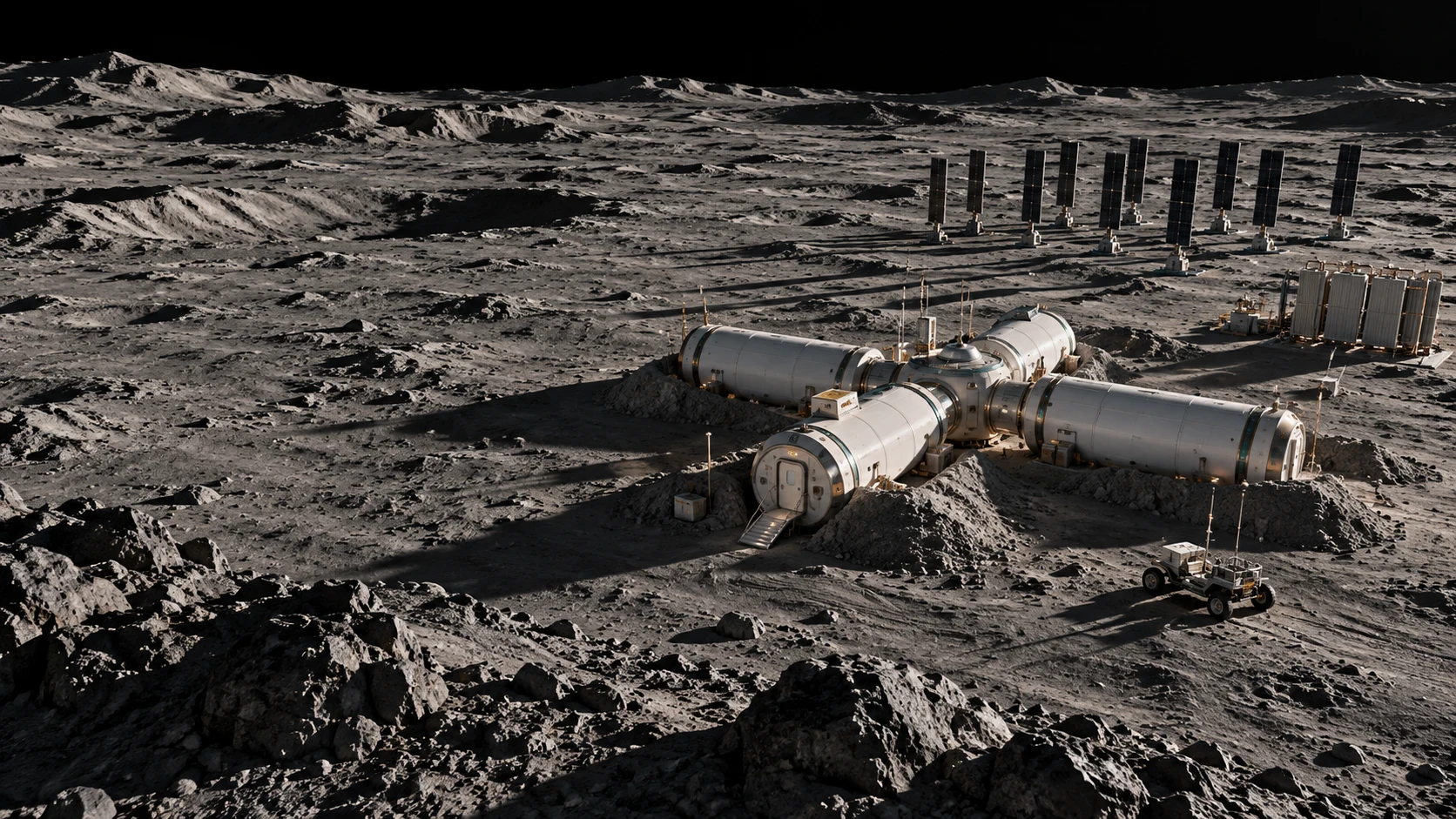
AI-GENERATED CONCEPT ART · NO BUILT STATION CLAIMED
CHAPTER 02 / CHOOSE THE GROUND
Follow the light across time
Concept study · 23 October 2026 Four crew / 30 days is a reference mission. Site, transport, safety case, mass budget and hardware remain open.
ARLO functional study 02 · conceptual relationships, not a construction drawing.
DESIGN NOTE 01
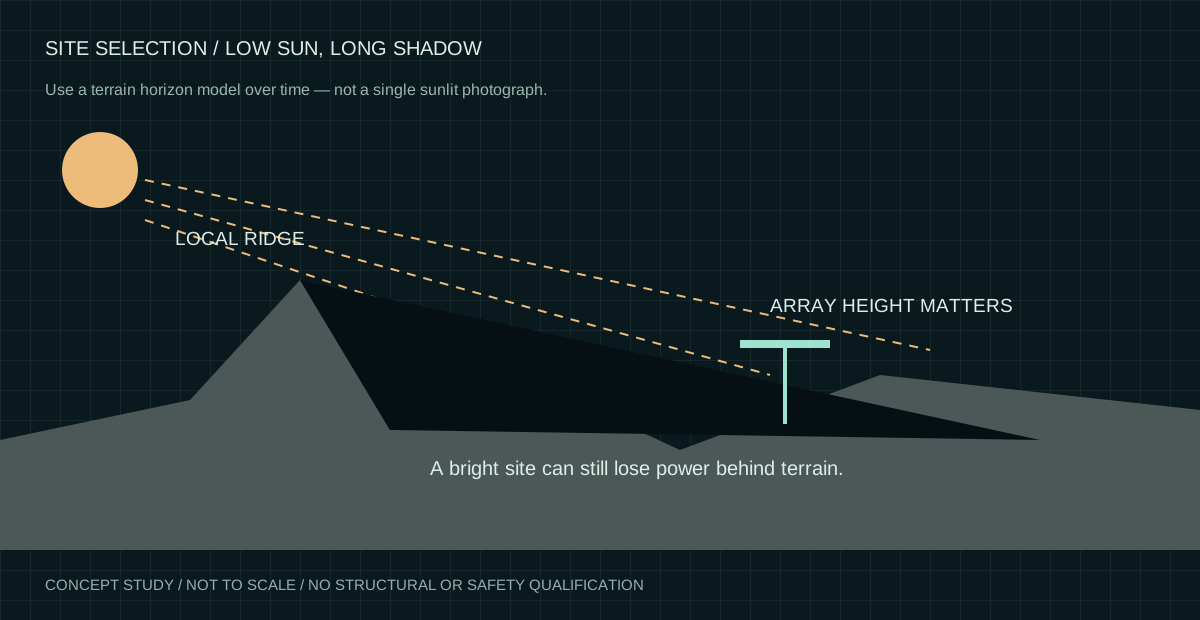
Follow the light across time
A bright ridge in one image is not a continuous power supply. At polar latitudes, low sunlight interacts with local relief, mast height and shadows cast by the station itself. Build a time-resolved horizon model from terrain data, evaluate multiple seasonal conditions, and identify the longest credible interruption. Our 72-hour outage calculator is a sensitivity example; it is not a measured blackout at an ARLO site.
DESIGN NOTE 02
Keep the landing problem separate
Landing zones need bearing strength, acceptable slopes, hazard clearance and a surface interaction model for the selected lander. Exhaust can mobilize regolith and threaten habitats, radiators and optics. The tour deliberately shows landing infrastructure outside the habitat cluster. It specifies no safe separation distance: that number must come from plume, ejecta and trajectory analysis, including future arrivals.
DESIGN NOTE 03
Water is an investigation, not a utility
Ice in some permanently shadowed terrain is scientifically and commercially interesting. Extraction requires prospecting, excavation, energy, processing and contamination control. The first ARLO crew carries its water and contingency supply from Earth. A future pilot could establish recoverable concentration, variability and production energy before resource extraction joins the survival chain.
DESIGN NOTE 04
The site-selection deliverable
Compare at least three candidate locations using a consistent matrix: illumination gaps, local slope, boulders, soil properties, line of sight to Earth or contracted relays, science value, traverse difficulty and landing hazards. Carry uncertainty with every score. Select only after orbital mapping is supported by in-situ observations and the power, communications and transport teams agree on one operating envelope.
Research behind this chapter
Lunar south-pole environment ↗ — NASA; terrain, illumination and environmental constraints. Regional information does not select an ARLO site.
Moon water and ices ↗ — NASA Science; evidence for water does not establish accessible reserves at our unselected location.
Sources checked 23 October 2026. ARLO-specific architecture and numbers are proposed assumptions. Public research references do not imply endorsement or partnership.