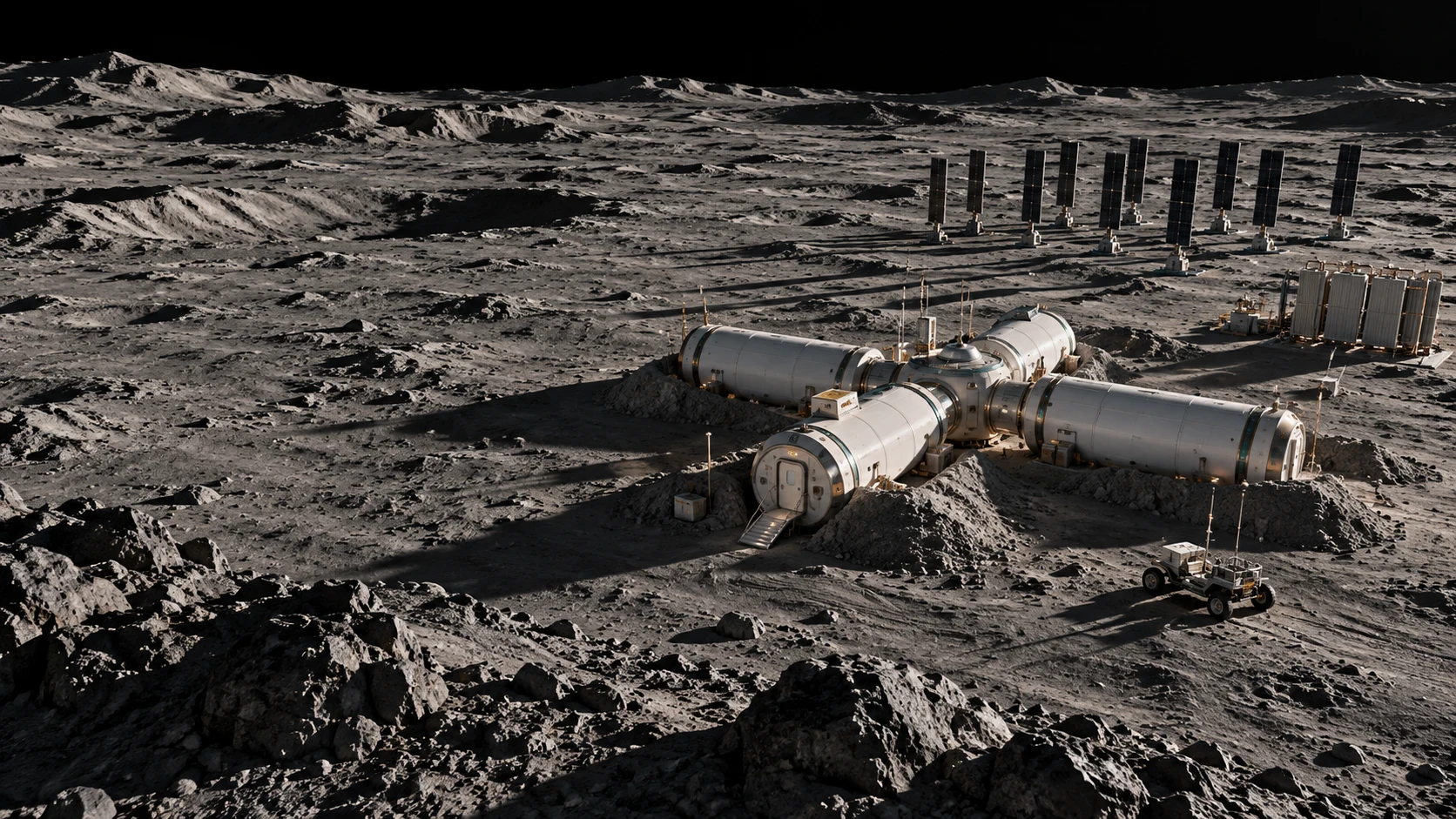
AI-GENERATED CONCEPT ART · NO BUILT STATION CLAIMED
CHAPTER 06 / POWER & HEAT
A reference load, not a vendor specification
Concept study · 23 October 2026 Four crew / 30 days is a reference mission. Site, transport, safety case, mass budget and hardware remain open.
CHANGE THE ASSUMPTIONS / SEE THE CONSEQUENCES
How much is enough?
Nominal battery capacity
Battery mass at illustrative 150 Wh/kg
Idealized effective radiating area
Storage = load × outage ÷ (0.90 efficiency × 0.80 usable fraction). Battery mass excludes reserve and environmental/aging penalties. Radiator assumes the same numerical heat load as electrical demand, emissivity 0.9, sink 3 K, no sunlight or terrain heating. Idealized values are not equipment selections. Sliders do not establish station feasibility.
ARLO ORIGINAL / ANIMATED EXPLAINER
Sunlight, storage and the long shadow
Read the film transcript
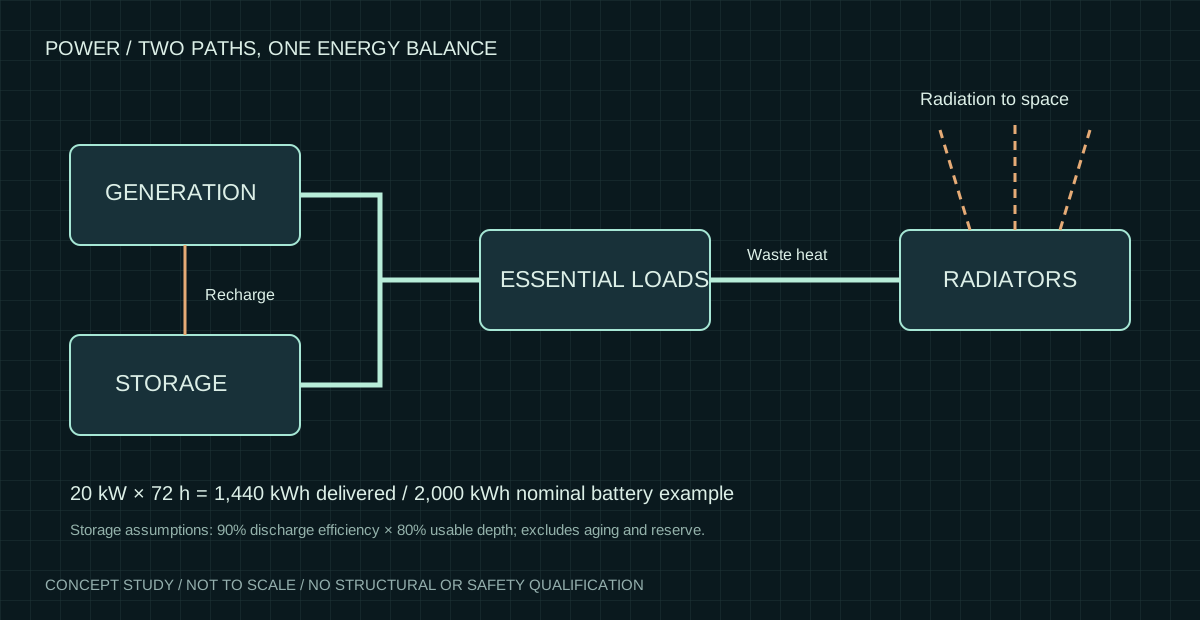
Solar generation serves essential loads and charges storage. During darkness, stored energy supplies the bus. Electrical demand becomes heat that must be rejected. At 20 kW and 72 hours the example needs 2,000 kWh nominal storage; the complete environment and reserves are not included.
Silent, captioned concept animation. Illustrates the design logic; does not depict built hardware or measured performance.
ARLO functional study 06 · conceptual relationships, not a construction drawing.
DESIGN NOTE 01
A reference load, not a vendor specification
The first power trade uses 20 kW average electrical demand and a provisional 30% allocation margin, giving 26 kW for planning. Actual loads must be built from equipment duty cycles, startup surges, EVA operations, science and contingency modes. Separate essential loads from equipment that can be shed. A single average cannot establish bus, inverter or cable sizing.
DESIGN NOTE 02
Darkness makes storage large
At 20 kW for 72 hours, delivered energy is 1,440 kWh. At 90% discharge-path efficiency and 80% usable depth of discharge, nominal battery capacity would be 2,000 kWh before aging, temperature effects and reserve. At an illustrative pack-level 150 Wh/kg, that is about 13.3 tonnes of batteries alone. These assumptions reveal why site choice, shorter crew visits, lower loads, fuel cells and eventual fission deserve a formal trade.
DESIGN NOTE 03
Solar first does not mean solar only
Tracking arrays need an illumination and shading model, dust allowances, thermal derating, deployment reliability and recharge time. To recover energy after a blackout, generation must serve the live load and charge storage. Fission is a credible development direction, but an ARLO reactor is neither procured nor qualified. No reactor output is counted as available station power.
DESIGN NOTE 04
Radiators close the energy balance
Most electricity used inside ultimately becomes heat. In vacuum, external heat rejection relies primarily on radiation. A screening model uses Q = emissivity × Stefan–Boltzmann constant × area × (radiator temperature⁴ − effective sink temperature⁴). The calculator assumes a cold idealized sink and emissivity 0.9. Real design must include terrain infrared, sunlight, view factors, dust, fluid loops and failure isolation; effective radiating area is not necessarily panel footprint.
Research behind this chapter
Lunar south-pole environment ↗ — NASA; terrain, illumination and environmental constraints. Regional information does not select an ARLO site.
Fission surface power ↗ — NASA development program; cited as a technology direction, not an available ARLO product or partnership.
Sources checked 23 October 2026. ARLO-specific architecture and numbers are proposed assumptions. Public research references do not imply endorsement or partnership.