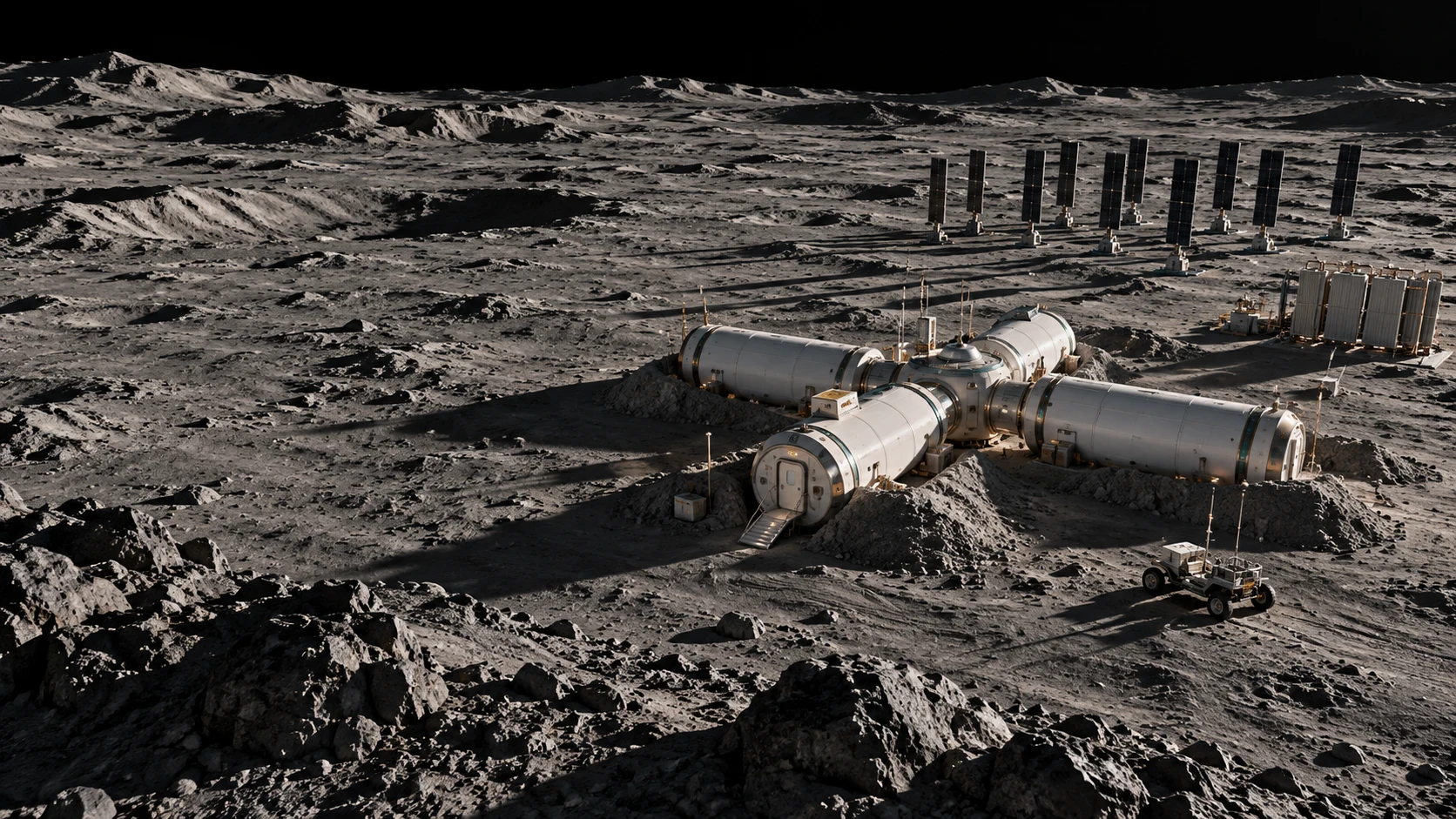
AI-GENERATED CONCEPT ART · NO BUILT STATION CLAIMED
CHAPTER 09 / SCIENCE & OPERATIONS
Measure the place we are entering
Concept study · 23 October 2026 Four crew / 30 days is a reference mission. Site, transport, safety case, mass budget and hardware remain open.
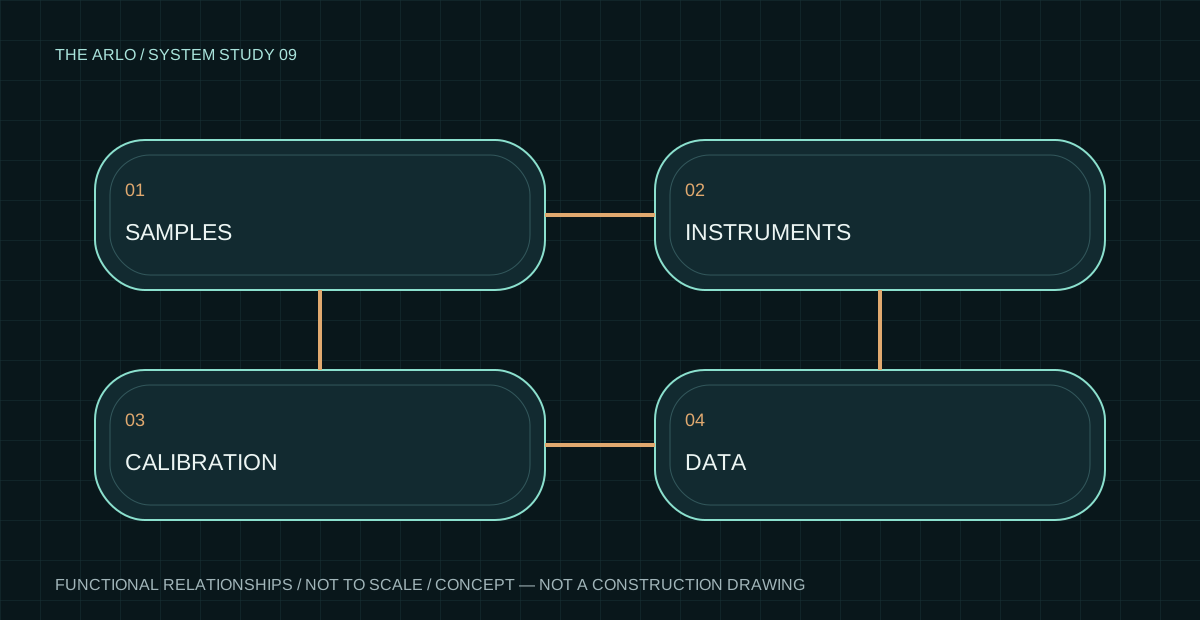
ARLO functional study 09 · conceptual relationships, not a construction drawing.
DESIGN NOTE 01
Measure the place we are entering
Early payloads can investigate dust transport, surface charging, thermal cycling, regolith mechanics and the local radiation environment. These observations also improve station design. Requirements should state measurement uncertainty, contamination limits, time resolution and calibration needs rather than promising discoveries in advance.
DESIGN NOTE 02
Keep industrial ambitions on a separate branch
Water extraction, oxygen production from regolith and construction-material demonstrations may become valuable. They require their own mass, energy, thermal and safety budgets. Initial tests should run as bounded payloads that cannot compromise survival services. Production enters the mission baseline only after independent measurements establish yield, reliability and maintenance demand.
DESIGN NOTE 03
Operations are part of the experiment
Track every maintenance hour, spare consumed, dust intrusion and interrupted science run. Plan crew schedules around exercise, inspection, rest and contingency tasks. Robotic operations can extend the scientific return between crew visits, but only with verified power, communications, environmental survival and remote recovery capability.
DESIGN NOTE 04
A research interface for real partners
A useful payload proposal defines dimensions, mass, average and peak electrical demand, heat dissipation, data volume, external field of view, crew time, sample handling and hazards. ARLO has no reserved payload slots or operational services for sale. We are seeking requirements and engineering review to establish which investigations deserve a place in the first mission.
Research behind this chapter
Lunar south-pole environment ↗ — NASA; terrain, illumination and environmental constraints. Regional information does not select an ARLO site.
Moon water and ices ↗ — NASA Science; evidence for water does not establish accessible reserves at our unselected location.
Human-rating guidance ↗ — NASA requirements portal; applicability and current revisions must be established by the mission authority.
Sources checked 23 October 2026. ARLO-specific architecture and numbers are proposed assumptions. Public research references do not imply endorsement or partnership.