A station with a purpose
The ARLO begins with a practical ambition: create a dependable orbital workplace where a small crew can operate carefully selected research payloads. Materials, optical instruments, fluid systems and biological experiments each need a defined reason to leave Earth. Microgravity is an experimental condition, not a guarantee of a better result.
Start small. Design for connection.
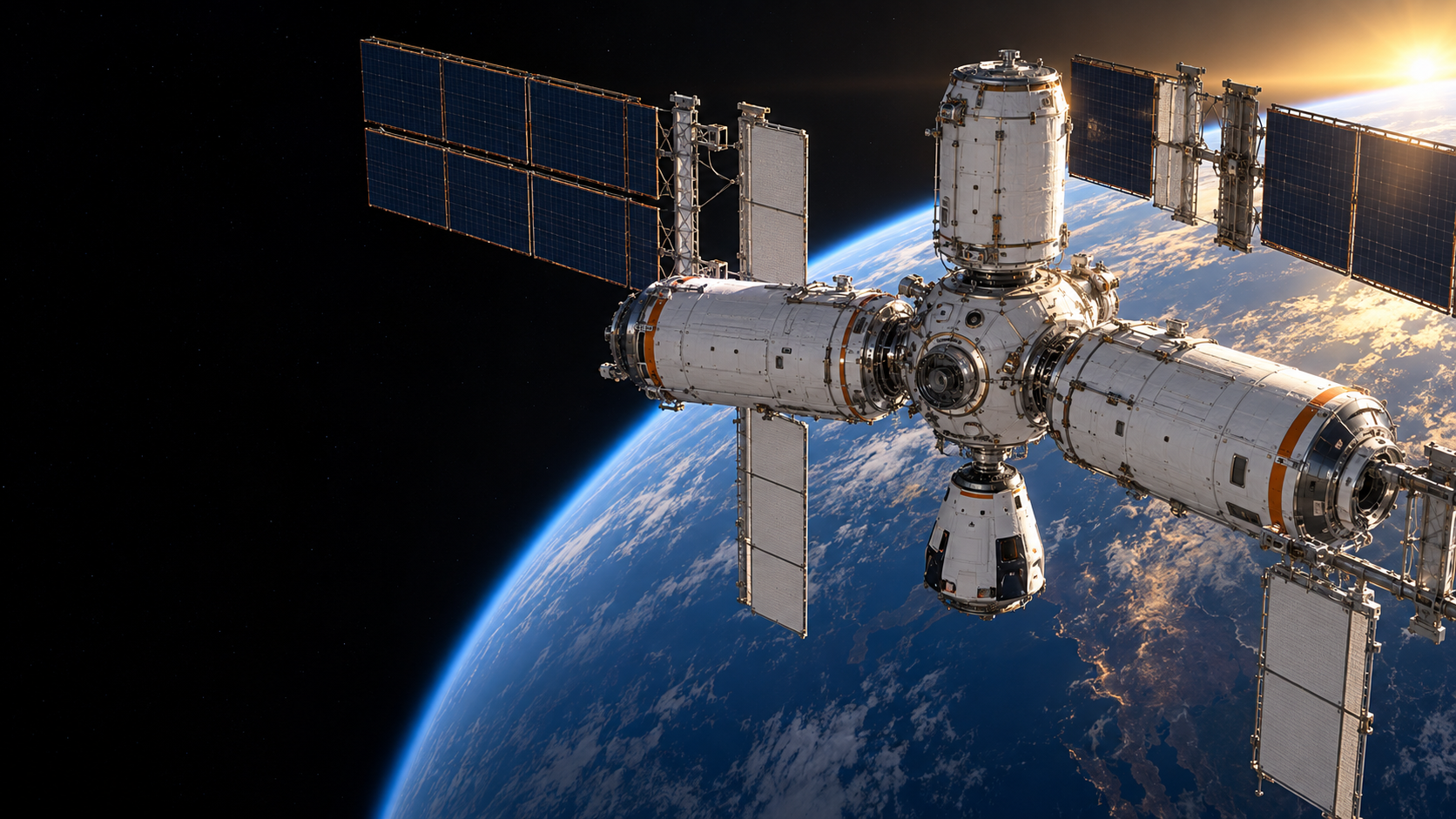
Our reference concept uses a central node, a habitat, a laboratory and a service module. Solar arrays provide electricity; batteries carry loads through eclipse; radiators reject heat. Conventional thrusters handle orbit maintenance and disposal. A compatible crew vehicle remains docked whenever people are aboard. The station does not depend on an unverified propulsion or energy technology.
Original engineering animation / 16 seconds
A station, one connection at a time.
Silent conceptual animation. The node appears first, followed by habitat, laboratory and service module. Utility wings complete the layout. This illustrates connections, not a validated launch sequence. Every intermediate flight configuration needs independent systems and a reviewed assembly plan.
Read the visual transcript
The node appears first, followed by habitat, laboratory and service module. Utility wings complete the layout. This illustrates connections, not a validated launch sequence. Every intermediate flight configuration needs independent systems and a reviewed assembly plan.
The first mission to design
Study a four-person, 30-day initial occupied mission after an uncrewed checkout campaign. A roughly 400 km circular orbit is a starting case, with inclination, launch site, traffic, radiation, communications and transport access still to be traded. These values help expose requirements; they are not contracted performance.
From a vision to a program
The next deliverable is a reviewed mission requirements baseline and a closed mass, power, thermal and logistics budget. Manufacturing drawings, funded suppliers, test evidence and launch contracts come later. The ARLO currently exists as a concept study. This experience shows what it would take to make it real.
Research basis / reviewed 23 October 2026
- NASA · Commercial space station program ↗
- NASA · ISS assembly elements ↗
- NASA · Human-rating guidance ↗
Sources establish engineering context, not ARLO performance. Numerical allocations are our provisional study assumptions. Images are concept art; diagrams and animations are explanatory.
NEXT CHAPTER