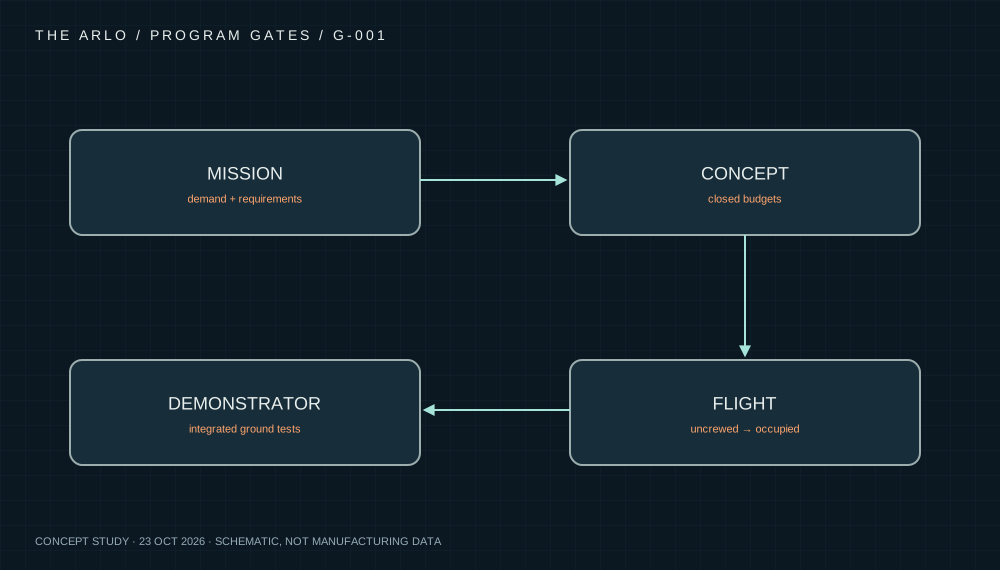
Gate 1 — Define the mission
Appoint a systems engineering lead and independent safety lead. Establish mission duration, crew size, payload demand, orbit trades and ownership. Produce a requirements document, concept of operations, hazard register, interface list and a versioned technical budget. The first decision is whether a dedicated station is justified versus buying capacity on another platform.
Gate 2 — Close the concept
Obtain nonbinding supplier studies for pressure modules, life support, power, thermal systems, docking and transportation. Reconcile mass, volume, power, heat, crew time, resupply and disposal. Conduct an independent concept review. No launch date or total price is published because a credible estimate needs supplier scope, qualification plans, schedule, contingency and operations costs.
Gate 3 — Demonstrate on the ground
Build a representative integrated demonstrator and human-factors mockup. Test fault cases and maintenance, not just nominal operation. Ground verification should retire the largest technical and integration risks before the program commits to flight hardware. Defined exit criteria govern the next funding decision.
Gate 4 — Qualify, commission, then occupy
Complete design reviews, qualification, contracts and authorization. Launch and commission the station uncrewed with representative loads. Demonstrate power and thermal performance, pressure integrity, communications, control, docking and contingency behavior before an independent crewed flight-readiness review. Research services become an offer only after the required capability and agreements exist.
The commercial question
Candidate customers include research organizations, payload developers and government programs. NASA’s commercial destination program is a relevant market reference, not an ARLO partnership or award. Demand must be tested through specific payload requirements and procurement pathways. The first conversation should identify a measurable need and what evidence would make a customer commit.
Prepare a nonconfidential introduction
What can you help make possible?
This brief stays in your browser until you copy or submit it elsewhere. Do not include confidential designs. No reservation, investment or flight booking is made here.
Research basis / reviewed 23 October 2026
- NASA · Commercial space station program ↗
- NASA · Commercial LEO Destination procurement ↗
- NASA · Human-rating guidance ↗
Sources establish engineering context, not ARLO performance. Numerical allocations are our provisional study assumptions. Images are concept art; diagrams and animations are explanatory.
BACK TO ARRIVAL