Reference geometry
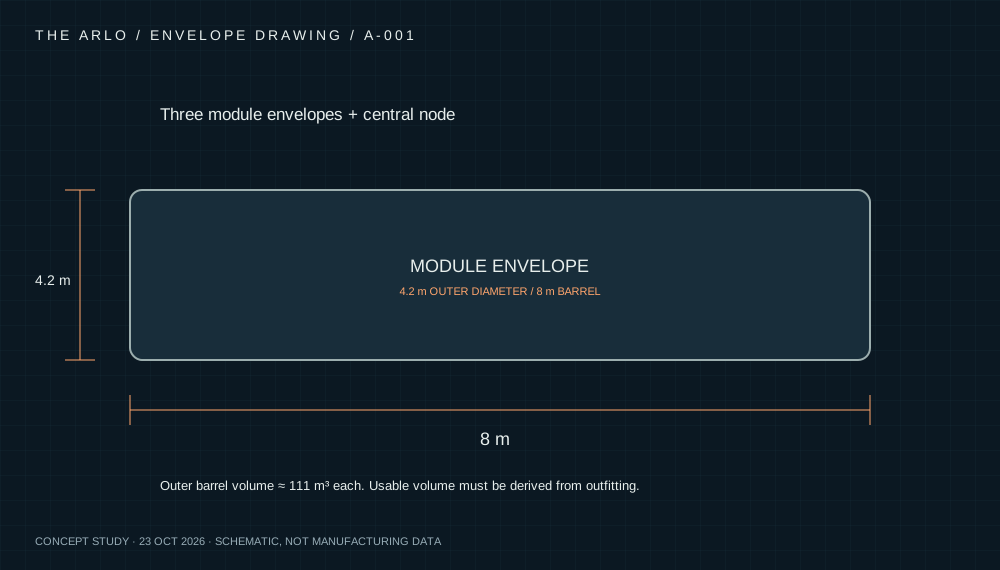
For layout studies, use three cylindrical module envelopes, each 4.2 m in outer diameter with an 8 m barrel, plus a compact central node. A barrel’s outer-envelope volume is πD²L/4 ≈ 111 m³. That is not habitable volume: pressure-shell thickness, end structures, racks, ducts and stowage consume space. A provisional 180 m³ total usable-volume target must be verified with a human-factors layout.
Drag to rotate / accessible button controls below
Envelope visualization. Rectangular proxies represent module bounds; pressure modules are cylindrical. Wing size is illustrative and does not encode the calculator’s active area.
Mass is a design constraint
The working allocation is 16 tonnes for habitat and outfitting, 13 for laboratory and payload accommodation, 6 for node and docking hardware, and 10 for service, arrays, radiators and propulsion hardware: 45 tonnes dry before margin. Adding a 20% concept margin gives 54 tonnes; a separate 6-tonne allowance for propellant, consumables and logistics gives a 60-tonne study case. These are analyst allocations, not a component roll-up or supplier estimates. The allocation may be inadequate and must be replaced by a bottoms-up budget.
Launch packaging comes before elegance
Choose launchers only after checking fairing dynamic envelopes, acoustic and vibration loads, payload attachment, center of gravity and insertion performance at the selected inclination. The drawing is a deployed arrangement, not proof that a module fits a particular rocket. The assembly sequence requires independent power, communications, attitude control and safe modes for every intermediate state.
Pressure boundaries and service routes
Each pressure module needs qualified structure, joints, windows where applicable, leak detection and isolation provisions. Routing must separate critical power and fluid paths against common-cause damage. The node is a potential single-point vulnerability: a compartment-by-compartment evacuation and depressurization analysis must resolve whether the proposed branching layout provides adequate survival paths.
Research basis / reviewed 23 October 2026
- NASA · ISS assembly elements ↗
- NASA-STD-8719.29 · Human-rating requirements ↗
- NASA-STD-3001 · Human systems ↗
Sources establish engineering context, not ARLO performance. Numerical allocations are our provisional study assumptions. Images are concept art; diagrams and animations are explanatory.
NEXT CHAPTER