Four candidate research lanes
Optical metrology could investigate environmental stability and sensor performance. Materials experiments could compare processing under reduced sedimentation or buoyancy. Fluid studies could examine interfaces and phase management. Biological experiments could compare cellular responses with matched controls. Each lane needs a specific hypothesis, a payload owner and a verified safety envelope before it earns station resources.
Microgravity is not silence
Crew movement, pumps, fans, docking, thrusters and structural motion disturb precision measurements. NASA uses acceleration measurements to characterize the ISS environment. ARLO should log acceleration spectra beside science data, schedule quiet windows, isolate sensitive payloads and establish recovery time after station maneuvers. No arbitrary micro-g performance is promised here.
An interface contract for every payload
A payload proposal must specify mass, center of gravity, electrical load and inrush, heat rejection, data rate, crew time, containment, materials compatibility, sample storage and return needs. Optical or biological hazards require their own review. Reserve capacity must be included in the station budget rather than allocated twice to different customers.
Evidence and ownership
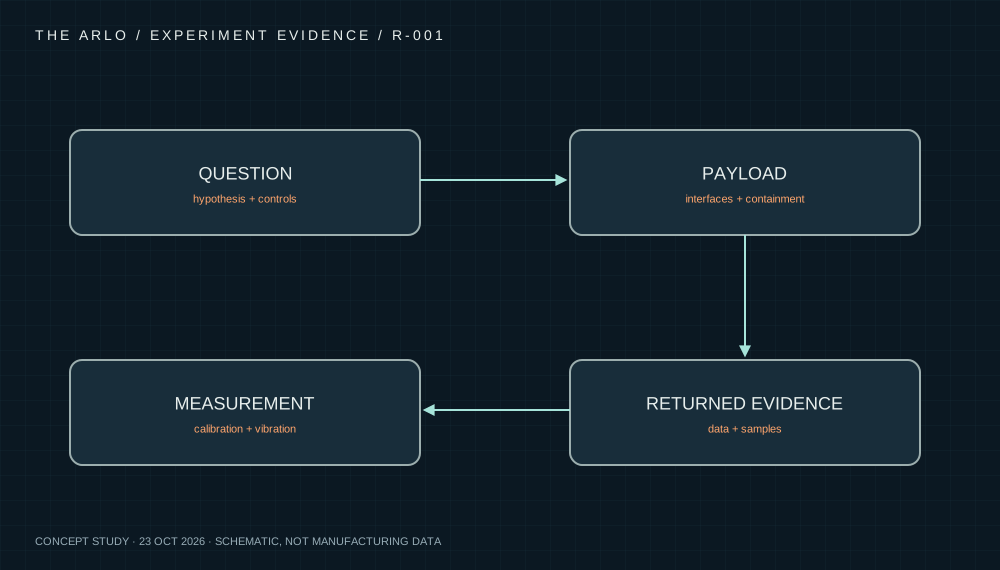
Write the test protocol, controls, calibration plan and success criteria before the flight. Agree on data ownership, publication, invention rights and sample custody in advance. Metric Flight’s existing research interests can inform candidates, but they do not establish that an orbital experiment is necessary or that a commercial result will follow.
Research basis / reviewed 23 October 2026
Sources establish engineering context, not ARLO performance. Numerical allocations are our provisional study assumptions. Images are concept art; diagrams and animations are explanatory.
NEXT CHAPTER