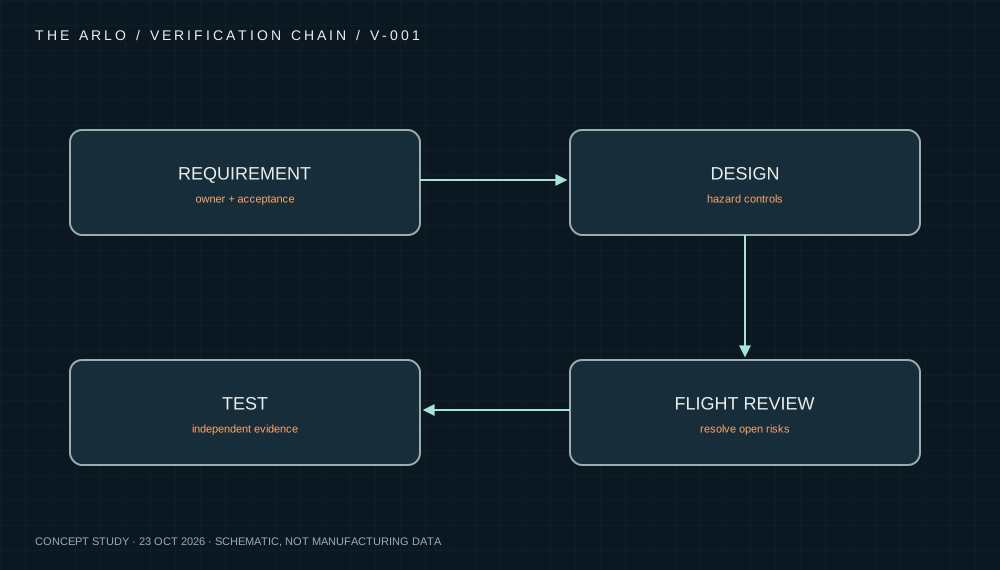
Build a requirement-to-evidence chain
Use NASA human-system and human-rating references as engineering inputs, then determine the applicable requirements with customers, authorities and independent specialists. Reading a standard does not certify ARLO. Every applicable requirement needs a verification method, responsible owner and objective acceptance record.
Resolve the dominant hazards
Pressure loss requires detection, isolation and reachable survival capability. Fire requires material controls, detection, suppression and smoke management. Toxic releases require containment and atmospheric monitoring. Electrical faults and battery events require propagation control. Radiation and debris need mission-specific transport and shielding analyses; a generic shield thickness would be misleading.
Test the integrated system
The campaign should include material and component qualification, structural and pressure verification, vibration and acoustic tests, thermal-vacuum testing, electromagnetic compatibility, software verification, hardware-in-the-loop fault injection and representative crew operations. Independent review must assess common-cause failures and unresolved hazards before a crewed flight-readiness decision.
Authorize the whole mission
FAA launch and reentry licensing, FCC communications authorization and orbital-debris plans are relevant U.S. workstreams. Additional obligations depend on payloads, operator, customers and mission. This is a scope map, not a complete legal determination. Plan decommissioning, controlled disposal and financial responsibility at the start, rather than leaving them to the end.
Research basis / reviewed 23 October 2026
- NASA-STD-8719.29 · Human-rating requirements ↗
- NASA-STD-3001 · Human systems ↗
- FAA · Commercial Space Transportation ↗
- FCC · Orbital debris ↗
- FCC · Space station licensing ↗
Sources establish engineering context, not ARLO performance. Numerical allocations are our provisional study assumptions. Images are concept art; diagrams and animations are explanatory.
NEXT CHAPTER