A reference electrical balance
The interactive model assumes 1,361 W/m² sunlight, 30% cell efficiency and a 0.75 aggregate delivery factor for temperature, pointing, wiring and degradation. Four hundred square meters of active array area produce about 122 kW during sunlight in this model. This is not a supplier rating. Shadowing and attitude constraints require time-resolved orbital analysis.
Engineering workbench / reference assumptions
Can the energy balance close?
Equations, constants and limitations
T = 2π√(r³/μ); tₑ = T asin(Rₑ/r)/π
Psolar = 1361 × 0.30 × 0.75 × A / 1000
Prequired = Pload × [1 + tₑ/(T−tₑ)/0.90]
Enameplate = Pload × tₑ/60/(0.80 × 0.90)
Arad = 1.25 Q/[0.85 σ (300⁴−230⁴)]
Rₑ = 6371 km; μ = 398600.4418 km³/s²; σ = 5.670374419×10⁻⁸ W/m²/K⁴.
Charging round-trip factor for array sizing: 0.90. Battery discharge efficiency: 0.90; usable depth: 0.80. These are separate simplified assumptions. The zero-beta cylindrical-shadow approximation ignores penumbra. No array shadows, orbit perturbations, component outages, detailed battery aging or radiator view-factor solution are included. A positive margin is only a first screening result.
Survive the dark part of the orbit
A circular orbit near 400 km takes about 92.4 minutes in a two-body model. A cylindrical Earth-shadow approximation at zero beta angle gives about 36 minutes of eclipse. A constant 60 kW load needs about 36 kWh delivered during that eclipse. At 80% usable depth of discharge and 90% discharge efficiency, that requires roughly 50 kWh nameplate before reserve; an 80 kWh reference battery adds study margin. Aging, cell faults and temperature must be modeled separately.
Original engineering animation / 16 seconds
A complete orbit needs stored energy.
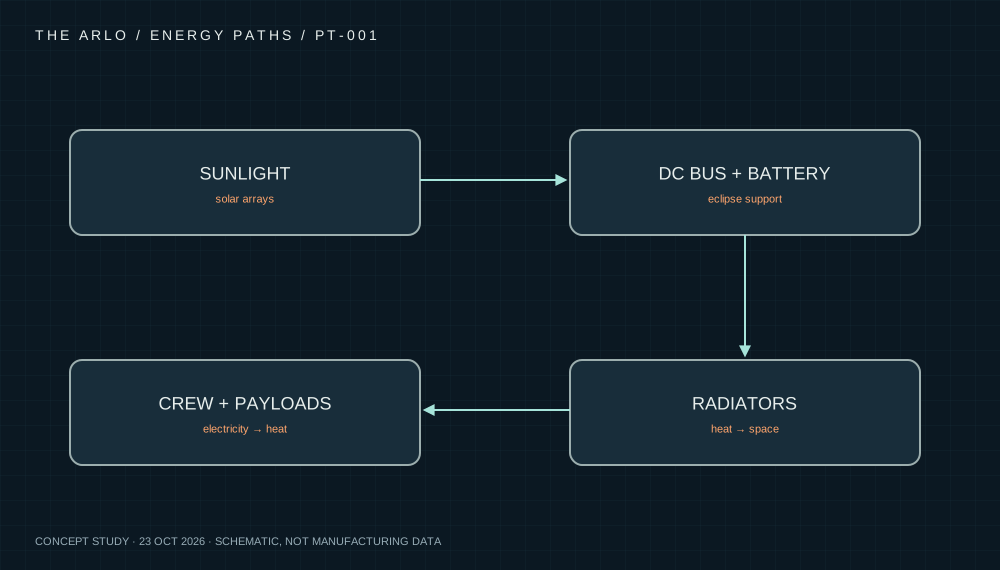
Silent conceptual animation. Sunlight supplies the station and charges the battery. During eclipse the battery supports the load. Heat moves from equipment to radiators throughout the orbit. The animation shows system roles, not measured performance.
Read the visual transcript
Sunlight supplies the station and charges the battery. During eclipse the battery supports the load. Heat moves from equipment to radiators throughout the orbit. The animation shows system roles, not measured performance.
Heat cannot disappear
For a 50 kW thermal load, a simple radiator model at 300 K, emissivity 0.85 and effective sink temperature 230 K gives approximately 196 m² of effective emitting area, or 245 m² with a 25% margin. The 260 m² reference area is emitting surface, not necessarily panel footprint. Real view factors, Earth infrared, albedo, solar loading, coating aging and fluid temperatures determine whether it works.
The coupled failure case
When power is constrained, shed payloads before essential crew systems. When a coolant loop fails, the allowable electrical load may also fall. Separate radiator loops, electrical isolation and batteries need a common-cause review. A positive number in this simplified calculator does not establish flight readiness.
Research basis / reviewed 23 October 2026
Sources establish engineering context, not ARLO performance. Numerical allocations are our provisional study assumptions. Images are concept art; diagrams and animations are explanatory.
NEXT CHAPTER