Standard interface, complete integration
The International Docking System Standard describes a standardized interface. An IDSS-compatible geometry does not automatically make two vehicles operationally compatible. Loads, capture behavior, approach sensors, communications, power transfer, pressure equalization, software, abort logic and crew procedures require an agreed vehicle-specific interface control document.
Keep arrival and escape paths clear
The concept reserves a return-vehicle berth and a separate logistics interface. Visiting vehicles must not obstruct solar arrays, radiators, sensors or departure corridors. Plume impingement, structural flexibility, collision geometry and line-of-sight need analysis across every configuration. The tour’s docking marker is a functional placeholder, not a certified port design.
Orbit is a shared decision
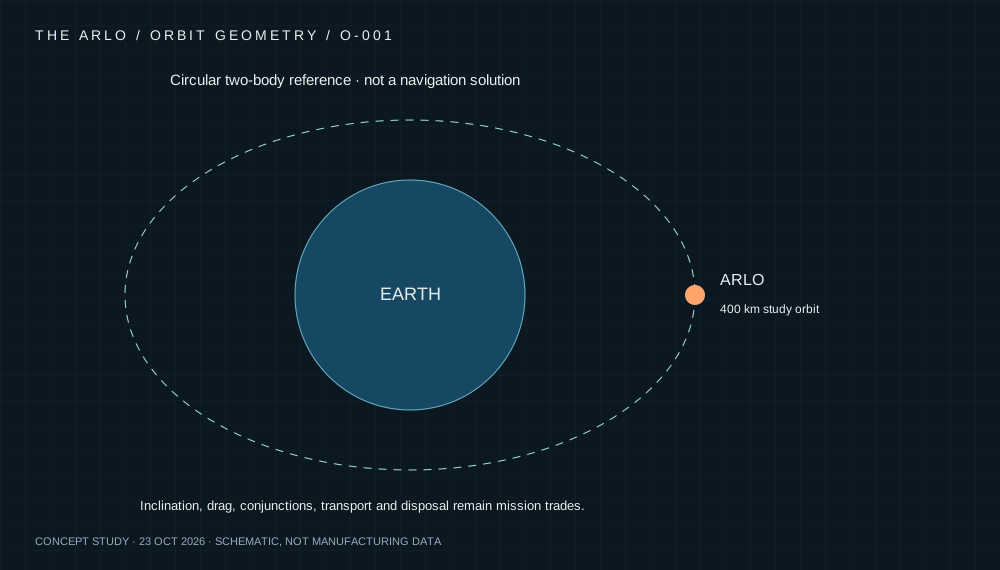
A 400 km reference altitude offers a familiar study environment, but drag varies with solar activity and attitude. Inclination changes launch performance and ground access. Coverage needs ground-station or relay agreements and link budgets. The station must support conjunction screening, maneuver authority, tracking and a safe mode during communication gaps.
Propellant is part of the mission
ARLO’s baseline uses conventional propulsion for reboost, attitude support where required, collision avoidance and controlled disposal. The propellant allocation cannot be closed without drag, maneuver, lifetime and disposal analyses. Metric Flight’s experimental propulsion research is a separate payload possibility, not the station’s survival system.
Research basis / reviewed 23 October 2026
- IDSS · Interface Definition Document, Revision F (2022) ↗
- NASA · ISS assembly elements ↗
- FCC · Space station licensing ↗
Sources establish engineering context, not ARLO performance. Numerical allocations are our provisional study assumptions. Images are concept art; diagrams and animations are explanatory.
NEXT CHAPTER