METRIC FLIGHT / PROPULSION RESEARCH
The next way
to move.
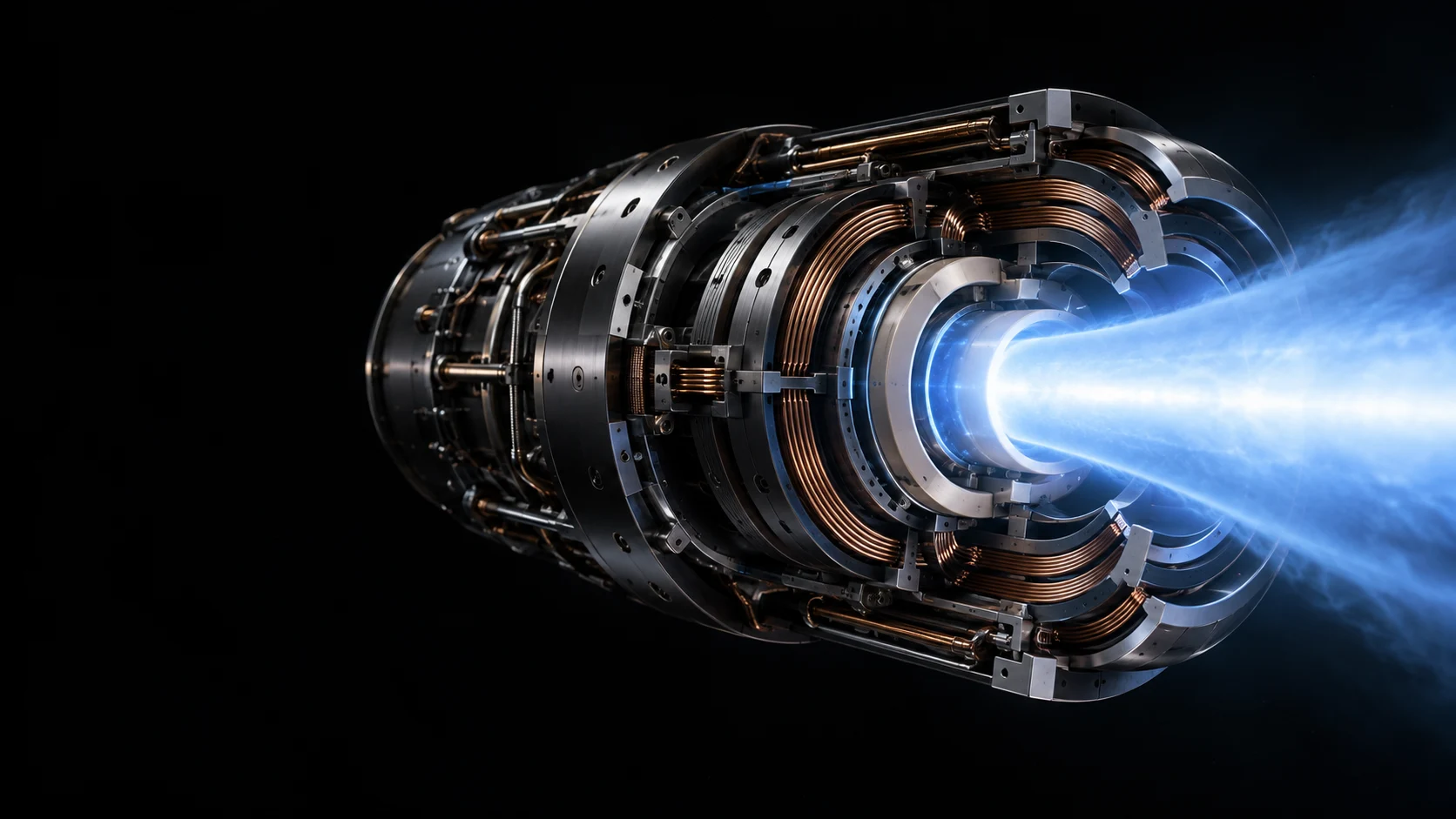
Shape the field. Direct the energy. Explore the engines that could carry our next chapter into space.
AI-GENERATED CONCEPT ART · PROPOSED RESEARCH PROGRAM
No Metric Flight engine or propulsion performance demonstrated.
THE OPPORTUNITY
Geometry can change
the way an engine works.
A magnetic field. A microscopic emitter. A precisely shaped flow. Different routes to the same question: can we move more effectively?
SIX CANDIDATES / SIX DIFFERENT QUESTIONS
Meet the mechanisms.
Selected for a clear momentum pathway, a research foundation and an opportunity to investigate geometry. Each profile separates published evidence from the proposed Metric Flight work.
01 / MAGNETIC NOZZLE
Shape the field. Guide the plasma.
Shape the field. Direct the exhaust. A magnetic nozzle turns the geometry of a field into a practical propulsion question: how much of the supplied energy leaves as useful axial momentum?
Explore magnetic nozzle ↗02 / ELECTROSPRAY
A small emitter. A precise impulse.
A small surface can become an engine. Electrospray uses carefully shaped emitters and electric fields to turn a conductive liquid into a controlled beam of ions or droplets.
Explore electrospray ↗03 / HALL & ION
Electric power. Directed momentum.
The strongest new engine must beat a real reference. Hall and gridded-ion propulsion provide established benchmarks for turning electrical power into spacecraft motion.
Explore hall & ion ↗04 / LASER THERMAL
Bring the energy. Keep the engine.
Put the energy source elsewhere. A laser-thermal vehicle receives light, heats propellant and sends that propellant through a nozzle. The beam supplies energy; the exhaust supplies most of the thrust.
Explore laser thermal ↗05 / LASER ABLATION
A pulse of light. A controlled recoil.
A pulse of light. A measured packet of momentum. Laser ablation offers a direct way to investigate how a surface turns absorbed energy into a controlled exhaust.
Explore laser ablation ↗06 / ELECTRODYNAMIC TETHER
A current. A planet. A momentum exchange.
Use the environment as the momentum partner. A conducting tether carrying current through a planetary magnetic field can change a spacecraft’s orbit without a conventional propellant jet.
Explore electrodynamic tether ↗MISSION FIRST / ENGINE SECOND
Where could it matter?
Precision in orbit
Small impulses, pointing stability and the complete spacecraft power budget.
Explore the requirements →The work between worlds
Study the requirements for cargo, station support and lunar logistics.
Explore the requirements →A longer horizon
Follow the power, propellant and thermal limits of deep-space transport.
Explore the requirements →DESIGN THE PROGRAM
From a mechanism
to a defensible decision.
Geometry & control
Separate field shaping, fabrication and active feedback.
The measurement standard
Controls, calibration and a comparison that can fail.
Research opportunities
Useful contributions in components, diagnostics and modeling.
Power & thermal
Count the parts that make an engine a spacecraft system.
Development gates
Make every new commitment depend on a specific result.
The evidence method
Keep research, assumptions and measurements distinct.
THE NEXT MOVE / BUILD THE EVIDENCE
A better engine begins
with a better experiment.
Bring a measurement, a materials capability or a mission requirement. Help turn a promising mechanism into a testable design.