START WITH CURIOSITY. FOLLOW THE EVIDENCE.
How far can we take controlled momentum?
Metric Flight begins with a small, measurable interaction: light arriving at a surface and leaving in another direction. The long-term question is whether better control of that interaction could become useful spacecraft engineering. This project connects that first experiment to a much larger vehicle concept, without skipping the work between them.
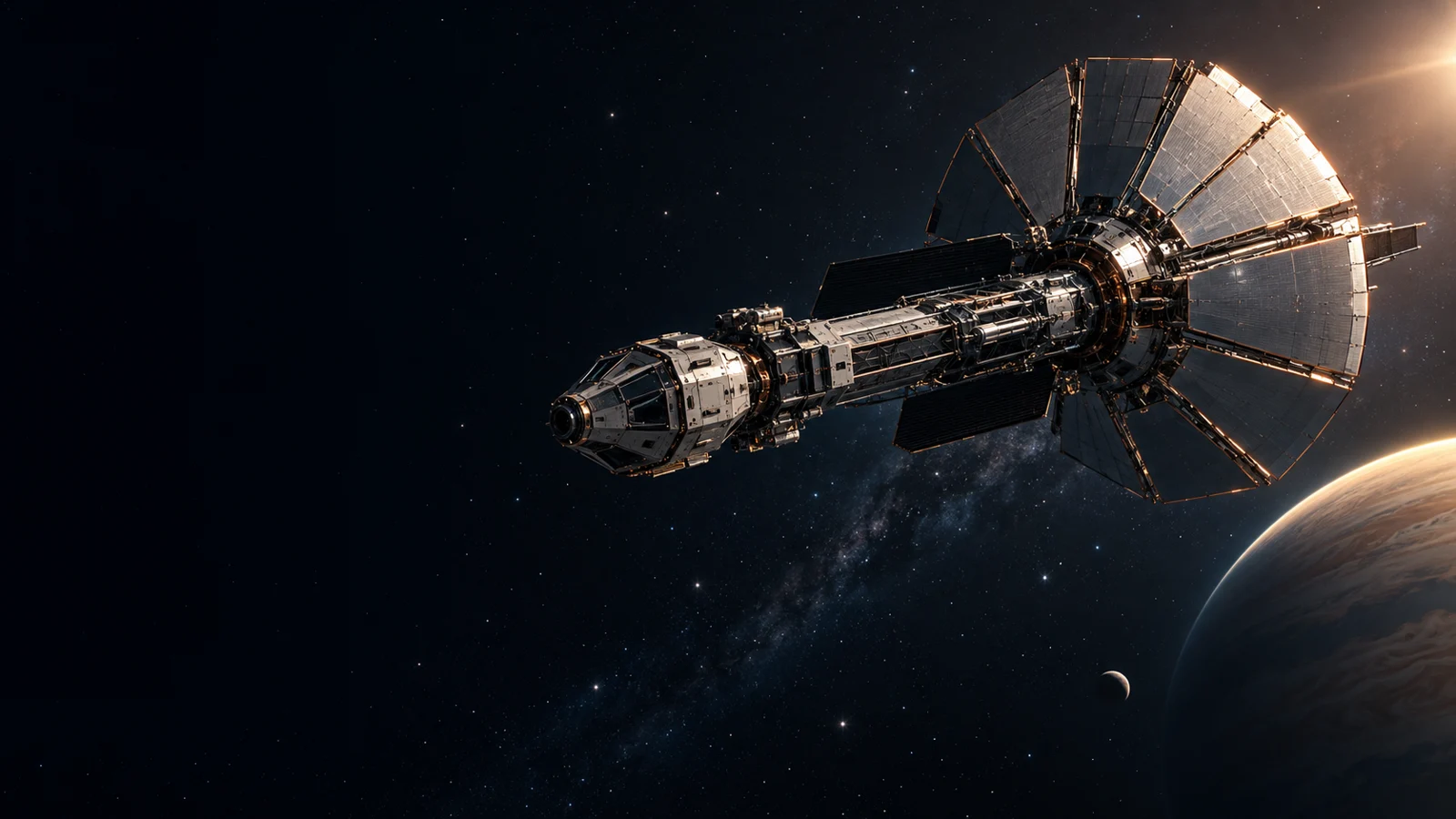
The ship shown here is an artistic research concept. Its optical panels, radiators and forward shielding communicate systems that an advanced vehicle would need to address. Their dimensions and performance are not a completed design.
Three horizons, one evidence trail
The first horizon is established physics: photon momentum, orbital energy exchange and relativistic kinematics. The second is engineering: useful optical efficiency, power delivery, thermal management, navigation and braking. The third is fundamental research: whether a precisely defined new interaction could survive existing constraints and independent tests.
These horizons are related questions, not interchangeable levels of readiness. A successful laboratory force measurement would qualify a measurement method. It would not establish an interstellar engine, a gravity-control system or faster-than-light travel.
Choose a route through the project
Start with the architecture if you want to understand the ship. Continue through light propulsion and gravity assists to see where its momentum could come from. Use the flight calculator to examine energy and travel time, then explore the halo-drive and spacetime literature with their limitations intact.
The final chapters bring the story back to an actionable research program: define the quantities, compare optical predictions with source data, validate the instrument and publish a result that another team can test.
Spacecraft architecture
Explore a conceptual interstellar spacecraft: optical surfaces, power, radiators, shielding, navigation and the systems that determine feasibility.
Photon propulsion and programmable momentum
Learn how photon propulsion works, why reflected direction matters, and how a 2 W reference measurement differs from a spacecraft propulsion system.
Gravity assists
Understand gravity assists, reference frames and why a planetary flyby can change a spacecraft orbit without breaking the speed-of-light limit.
Relativistic flight calculator
Calculate ideal kinetic energy, cruise time and traveler proper time below light speed, with explicit mass and distance assumptions.
The halo drive
Explore David Kipping’s theoretical halo-drive proposal, boomerang photons and the distinction between relativistic propulsion and faster-than-light travel.
Faster-than-light travel and spacetime research
Separate warp-drive mathematics from propulsion engineering, and examine what a credible faster-than-light research claim would need to establish.
Alpha 1 hypothesis
Inspect Alpha 1’s proposed field model, unresolved coupling, momentum accounting and requirements before any spacecraft or hardware claim.
Interstellar spacecraft engineering limits
Examine the power, heat, dust, navigation, communications and braking requirements behind an interstellar spacecraft concept.
Spacecraft research roadmap and collaboration
Follow the evidence gates from source verification and optical comparison to instrument qualification, independent replication and spacecraft studies.
Read the visual transcript
An external beam travels toward a surface. The reflected direction changes from 0 to 30 to 45 degrees and back to 30 degrees, measured from the backward normal. The recoil arrow changes with the outgoing momentum. This shows a single reflected channel, not all optical loss channels. No measured force is plotted.
Questions worth asking
Is this a spacecraft launch announcement?
No. It is a research and education project connecting a proposed measurement program to a speculative spacecraft concept.
Does gravity assist enable faster-than-light flight?
No. Ordinary gravity assists exchange orbital energy; they do not allow a massive spacecraft to cross the local speed of light.
SOURCES & SCOPE / REVIEWED 23 OCTOBER 2026
- Metric Flight: current MF-01 research package ↗Proposed measurement program, source records and open requirements.
- A Roadmap to Interstellar Flight — Philip Lubin ↗Directed-energy mission concepts and engineering scope.
External research is not Metric Flight performance. Concept images and diagrams are illustrative. This project introduces no new company experimental result.
NEXT CHAPTER