START HERE / THE NEXT CHAPTER OF METRIC FLIGHT
We asked how to move.
Now we’re asking
what we could build.
A propulsion question led us to a bigger engineering journey: a working station in orbit, a path to the Moon, and the evidence needed to connect them.
Here is what changed, why it matters, and what comes next.
Begin the story ↓Five chapters · about four minutes · research and mission concepts
01 / THE QUESTION THAT STARTED IT
Could geometry change
how we move through space?
We began with a difficult ambition: travel without carrying the propellant that conventional rockets need.
We investigated light, fields and engineered boundaries. But every proposed drive still has to answer one question: what takes away the opposite momentum? Our calculations have not established sustained thrust from internal geometry alone.
That result sets a boundary. It also helps us see where the engineering can be useful today.
Read what the investigation established ↗02 / THE USEFUL TURN
The magnetic field
can shape an engine.
In a magnetic-nozzle engine, plasma leaves the vehicle. That exhaust carries momentum away.
This is propellant-using electric propulsion. Our magnetic work helps us investigate field arrangements, coil demand and thermal constraints. A hybrid magnet arrangement is a candidate worth testing—not a demonstrated engine improvement.
Matching a magnetic field does not prove that thrust survives. First establish the reference engine’s momentum balance. Then change the magnets and measure what happens.
03 / GIVE THE ENGINE A MISSION
A station needs more
than a way to move.
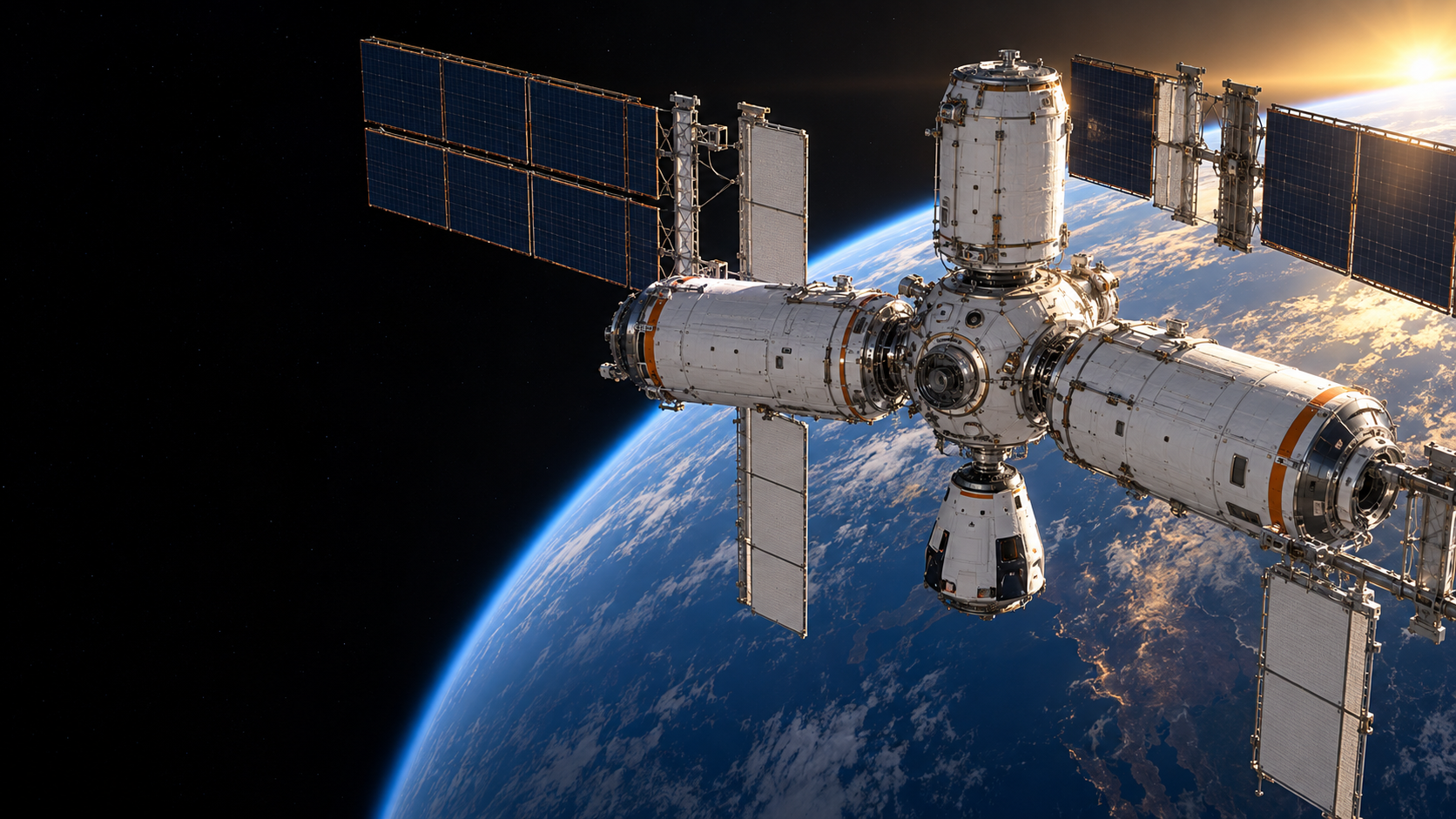
Imagine ARLO operating as an orbital workplace. Its crew, experiments, visiting vehicles and essential systems all share the same power, cooling and maneuver windows.
An electric engine could be assessed for scheduled orbit maintenance. It would also need electricity, a thermal interface, propellant and time. A useful engine has to fit the station—not merely perform well on a test stand.
Our illustrative 60-tonne case takes about 33 hours of firing to gain 1 m/s at 0.5 N. At 50% duty, that is about 2.78 days. These are assumed inputs, not measured magnetic-nozzle performance. Urgent maneuvers need their own capability.
Read the explainer transcript
Define the maneuver and its timeline. Scheduled low thrust needs time and available power. Time-critical maneuvers require separately sized capability. Validate the engine before station integration.
04 / EXTEND THE JOURNEY
The Moon is a destination.
Getting there is a chain.
Launch. Transfer. Landing. Ascent. Return. Each stage asks something different of the vehicle.
Electric propulsion could be studied for suitable uncrewed cargo transfers, where time and power permit. It does not automatically solve landing, rapid response or getting a crew home. The Moon station concept needs the complete transport chain.
Read the explainer transcript
Launch delivers the vehicle to space. Transfer propulsion delivers cargo to the lunar vicinity. Landing needs a separate descent design. Crew missions must close ascent and return before departure.
What carries forward is the discipline: define the mission, measure the engine, and close the interfaces. The station programs do not depend on a breakthrough in internal-only propulsion.
Explore the route to the Moon ↗05 / THE NEXT CHAPTER HAS TO BE MEASURED
Our next milestone
is a result we can trust.
The ambition stays large. The next experiment gets specific.
Measure thrust, propellant flow, chamber conditions, the electron population and complete electrical input at the reference operating point. Resolve facility effects. Then compare a changed magnetic assembly under declared conditions.
For ARLO and the Moon station, turn the concepts into reviewed requirements, coupled engineering budgets and supplier studies. Those are separate milestones; a successful laboratory experiment would not make a station flight-ready.
We have analysis, computational tools and proposed architectures. We have not demonstrated a new engine or a propellant-free drive. The opportunity is to turn the next credible result into useful hardware and a better mission design.