The station uses conventional propulsion in its baseline. Magnetic-nozzle research can inform a future electric-propulsion trade; it is not selected flight hardware or a crew-safety dependency.
Match propulsion to the job
| Mission job | Architecture to assess | Required evidence |
|---|---|---|
| Scheduled reboost | Conventional thrusters; electric propulsion trade where firing time and power permit | Drag envelope, duty cycle, lifetime, power and propellant reserves |
| Time-critical maneuver | Conventional system sized for the required response | Thrust authority, restart, fault tolerance and maneuver timeline |
| Attitude management | Attitude-control system with appropriate momentum unloading | Disturbance torques, pointing, control coupling and propellant budget |
| Controlled disposal | Dedicated, verified disposal capability | End-of-life power, reserve propellant, degraded-state operation and trajectory analysis |
| Experimental propulsion | Separately assessed research payload or uncrewed demonstrator | Ground validation, containment, plume compatibility and independent review |
Use the magnetic data in the right place
Magnetic-field models can help specify coil placement, trim authority, stray-field limits and thermal requirements. Plasma measurements can constrain plume geometry and required electrical input. A lower calculated coil demand is only valuable if the complete engine retains useful thrust and lifetime. Field agreement alone is not a propulsion acceptance test.
Close the station interfaces
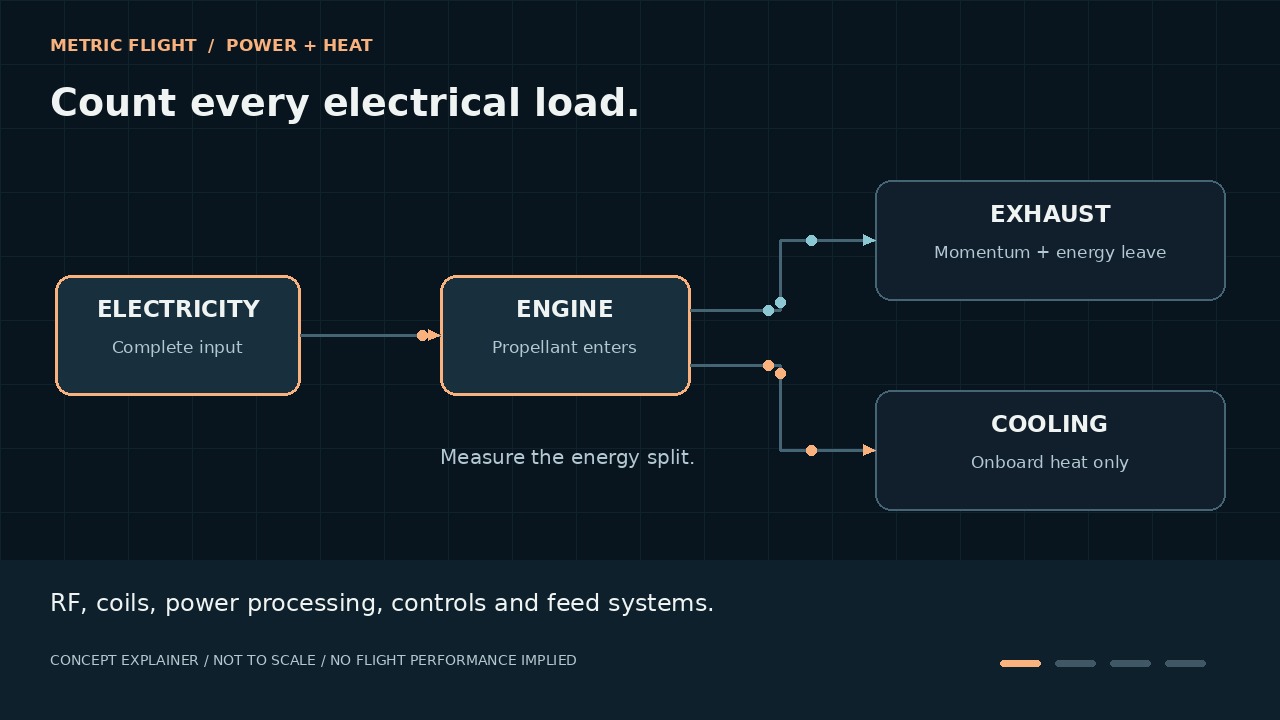
Count RF generation and matching, coils or magnets, power processing, gas storage and feed, radiator area, structural loads and control electronics. Check plume impingement on arrays, radiators, docking corridors and optical instruments. Assess electromagnetic interference, charging, magnetic compatibility and force-measurement disturbance. Protect quiet science windows and all crew-return paths.
A reference calculation, not a station engine claim
For an assumed 60-tonne initial mass, 1 m/s velocity change, 0.5 N constant thrust and 2,000 s Isp, the ideal model requires about 3.06 kg of propellant and 33.3 hours of firing. At 50% duty, that is about 2.78 days elapsed. Assuming 50% total electrical-to-jet efficiency gives 9.81 kW during firing. No actual candidate has been shown to achieve this combination. Drag during the maneuver, trajectory losses, eclipse storage and installed mass are excluded.
The adoption gate
First validate the engine on the ground. Then close a mission-specific mass, power, thermal, lifetime and safety case against an established comparator. Evaluate a dedicated uncrewed demonstration before proposing operational station use. ARLO does not wait for internal-only propulsion to become credible.
System architecture is proposed. See the research status and rocket technology comparison. No NASA partnership, flight qualification or procurement selection is implied.