NEW / ARLO THERMAL BUILD 02

Use the heat. Protect the cold.

Investigate how ARLO could use less electrical power while keeping its habitat and equipment at the temperatures they need. Follow the energy and compare three thermal configurations.

Explore the new design ↗

ARLO / ACTIVE SHIELDING / CONCEPT RESEARCH

Capture sunlight. Keep the magnet cold.

Explore the solar arrays, batteries and cooling needed for an ARLO magnetic-shield concept. Adjust a transparent preliminary power budget.

Explore the research ↓
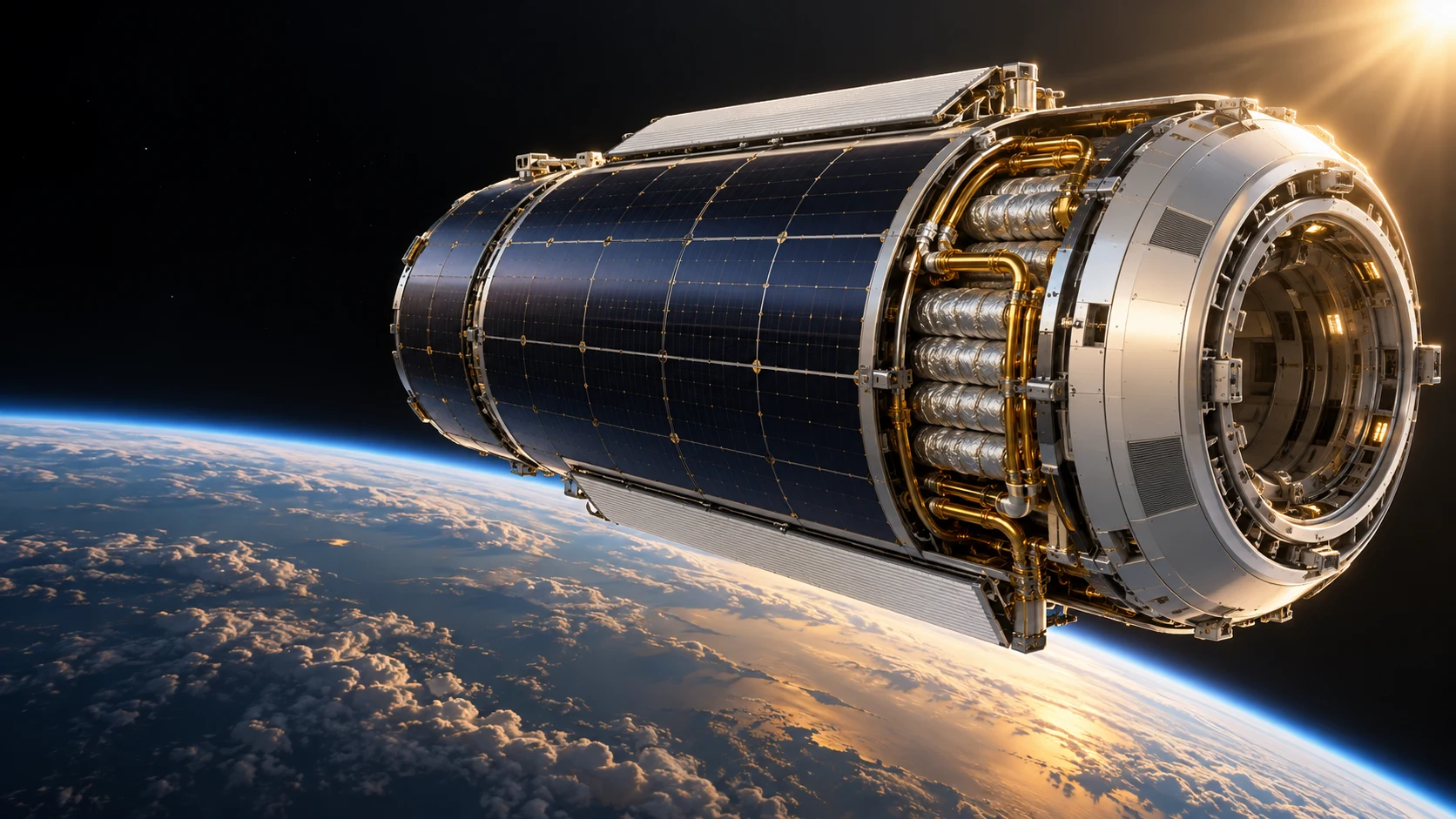
AI-generated solar research concept; not built hardware
Concept visualization · not a field solution or built hardware
Current evidenceLiterature + analytical modelNo measured ARLO shielding benefit
01SOLAR ARRAY

Sunlight supply

02POWER BUS

Loads + charging

03BATTERY

Eclipse supply

04COOLER

Cold-stage control

FUNCTIONAL RELATIONSHIPS · NOT A WIRING DIAGRAM

ILLUSTRATIVE SHIELD-ONLY BUDGET

How much solar does cooling require?

Change the assumptions. No input here is a measured ARLO specification. Constant load, one repeating orbit and complete recharge in the next sunlight interval are assumed.

Battery, temperature and radiator assumptions
Equations and system boundary

Pel = Qc/COP. Pload = Pel + Paux. Sunlight duration ts = torbit − te. Required sunlight power = Pload × [1 + te/(ts × ηcharge × ηdischarge)] × (1 + margin). Area = sunlight power / net EOL output density. Battery nameplate = Pload × te(hours) / (ηdischarge × usable depth) × (1 + margin).

Local warm-loop heat Qhot = Qc + Pel + Paux. Emitting radiator area = Qhot × (1 + margin) / [εσ(Trad⁴ − Tsink⁴)], with σ = 5.670374419 × 10⁻⁸ W m⁻² K⁻⁴. Auxiliaries are assumed to reject all their power into this loop. Battery losses, initial cooldown, magnet charging, emergency dumps and the rest of the station are excluded.

Output density includes the direct solar-to-load conversion path; battery efficiencies add only the storage path. Margin is applied separately to solar, battery and radiator capacities; it is not an additional operating load. End-of-life battery degradation beyond the chosen usable capacity must be supplied by a separate battery model.

01

A complete electrical architecture

Our proposed chain is solar arrays → regulated distribution → cooler and controls, with a bidirectional battery path for eclipse. A separate controlled supply energizes the magnet. Passive insulation and sunshades reduce cold-stage heat leak before electrical equipment is sized. This is an architecture to evaluate, not a selected flight system.

02

Superconducting does not mean power-free

A suitable superconducting circuit may carry current with very low resistive loss, but persistent operation cannot be assumed for an unspecified conductor, joint and switch design. Current leads, joints, trim circuits and power electronics may add losses. Enter their cold-stage contributions in cold heat and their warm electrical contributions in auxiliary load, without double counting.

03

Size sunlight power for the whole orbit

Arrays must serve daytime loads and restore the energy withdrawn in eclipse, including charging and discharging losses. Use net usable end-of-life output per deployed panel area, after temperature, radiation degradation, pointing, packing and distribution losses. The example value is an assumption, not a supplier rating. This tool sizes only the shield allocation; station life support, payloads and propulsion are excluded.

04

What the example means

The default case assumes 40 W cold-stage heat and a cooler coefficient of performance of 0.02, giving 2 kW cooler electricity. Adding 300 W auxiliaries gives a continuous 2.3 kW load. These are deliberately adjustable study inputs; they have not been derived from ARLO coil geometry. A real coil may require substantially more or less power.

05

Engineering gate before procurement

Freeze coil current, conductor and temperature margins; compute heat leaks and obtain a cooler performance map. Then close an orbit-resolved load and recharge model, battery cycle-life assessment, array pointing and shadowing analysis, packaging, redundancy and structural interactions. The calculator is an energy-balance screen, not a procurement specification.
Research foundations

External work informs the study; it does not validate ARLO. Review date: 24 October 2026. Source access depth is stated below.

  1. NASA MAARSS engineering study, 2019 ↗

    Architecture, structural loads, quench protection and cooling; report summary reviewed.

  2. CREW HaT, Desiati & D’Onghia, 2022 ↗

    Preliminary magnetic habitat concept; abstract reviewed, not flight validation.

  3. Hesse-Withbroe & Arquilla, 2025 ↗

    Modeling preprint; revised strong-field performance. Abstract reviewed.

  4. NASA LEO station radiation environment, 2024 ↗

    Orbit-specific environment reference; presentation.

  5. NASA thermal-control overview ↗

    Engineering context for coatings, heat rejection and environment.

  6. ESA spacecraft impact shielding ↗

    Physical debris protection remains a separate system.

  7. NASA spacecraft power systems ↗

    Solar generation, eclipse storage and end-of-life considerations; overview reviewed.

FOLLOW THE DESIGN

Explore the next question.

ARLO active shielding researchExplore magnetic radiation shielding, MatterVolt surface research and a staged protection study for the ARLO station.Explore ↗How magnetic radiation shielding worksUnderstand magnetic rigidity, particle energy, field direction and why a magnetic field is not a universal barrier.Explore ↗ARLO radiation environment and protection tradeCompare low Earth orbit radiation hazards with deep-space shielding concepts before sizing an ARLO protection system.Explore ↗MatterVolt surfaces for ARLO shielding researchConnect MatterVolt optical boundary research to spacecraft surface and thermal studies without confusing optics with cosmic-ray shielding.Explore ↗ARLO superconducting shield concept designStudy candidate coil layouts, cryogenic loads, quench protection, docking access and passive shielding for ARLO.Explore ↗ARLO shielding validation and evidence gatesA staged validation plan for magnetic radiation shielding and MatterVolt surface concepts, from baseline models to independent review.Explore ↗Proton magnetic rigidity calculatorCalculate relativistic proton rigidity and uniform-field curvature radius. Educational tool, not a radiation dose or shield-design calculator.Explore ↗ARLO magnet cooling and radiator designSeparate magnet heat leakage, cryocooler electricity and warm-end radiator rejection in the ARLO shielding concept.Explore ↗ARLO magnetic shield eclipse and failure operationsPlan battery reserve, magnet energization, cooldown and fault handling for a solar-powered ARLO shielding study.Explore ↗

Help test the protection concept.

We are defining a research scope for radiation transport, superconducting engineering and optical-material testing. No shield is offered for sale or operational use.

Discuss a technical contribution ↗Return to ARLO ↗